Israel is our partner for promoting peace, prosperity and progress in the Middle East. America and Israel share a mutual interest and desire to work with others in the region.
Israel is the strongest of America’s allies in the Middle East. It is in our strategic interest to help forge lasting ties between the Jewish state and our Arab allies, allowing them to work together to counter shared threats, enhance regional stability and bolster their economies. Stability in the Middle East reduces the threat to America, our servicemembers and our interests.
Since its founding, the Jewish state has extended an open hand in peace to its neighbors. And when it has the unwavering support of the United States, Israel has been willing to make painful sacrifices and security compromises to achieve true and lasting peace.
Yet for much of its history, Israel has been shunned by Arab neighbors that swore in 1967 that there would never be negotiations, recognition or peace with Israel. That position cracked in the subsequent decades as Israel reached peace accords with Egypt and Jordan, and signed the Oslo Accords with the Palestinians. Unfortunately, since 2014, Palestinian leaders have refused to negotiate with Israel.
However, four Arab states provided grounds for hope in 2020. The United Arab Emirates (UAE), Bahrain, Sudan and Morocco agreed to normalize relations with Israel, ushering in a new era for peace and cooperation. These historic agreements—mediated by the United States—are opening the opportunity for true economic breakthroughs that will benefit citizens of all countries involved while strengthening security partnerships and regional stability.
The recent historic peace agreements—supported by overwhelming bipartisan majorities of the House and Senate—advance American interests. Strong U.S.-Israeli relations were an essential prerequisite for this progress. These new relationships benefit America by bringing our regional allies together in pursuit of our common interests, including greater peace and prosperity.
The UAE, Bahrain, Sudan and Morocco—in addition to Egypt and Jordan—each have political differences with Israel. But all these states have embraced diplomacy and peace with the Jewish state to achieve a better future for their people.

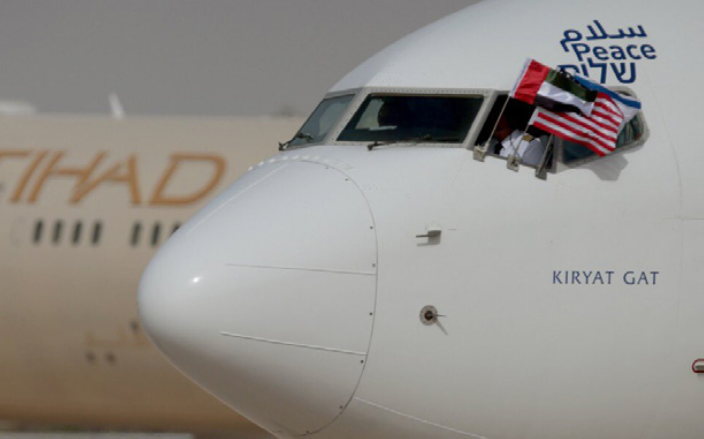
Normalization between Israel and its neighbors opens new avenues for progress, including enhanced cultural, scientific and business cooperation that benefits the region and America alike. These agreements have already produced new commercial flights, trade routes, and public and private sector agreements and cooperation—promising tremendous economic benefits to the countries involved, the broader region and the United States.
Increased normalization through regional trade, investment and innovation open the door to a brighter future for all.
In 2022, Bahrain, Egypt, Israel, Morocco, the United Arab Emirates and the United States established the Negev Forum as a framework for regional cooperation. The Forum has six working groups, focused on clean energy, education and coexistence, food and water security, health, regional security and tourism.
The Abraham Accords offer a clear model to a safer and more prosperous region that greatly promotes American interests.
As more Arab leaders forge ties with Israel, they are not only expanding the opportunities for their people but also increasing the prospect for broader Israeli-Arab and Israeli-Palestinian peace.
The Palestinian people suffer directly from their leaders’ refusal to return to direct talks. Palestinian leaders should resume peace talks with Israel while following the lead of the UAE, Bahrain, Sudan and Morocco to create economic opportunities for their people.
Arab views of the Israeli-Palestinian conflict are changing. Direct negotiations and normalization offer the best path for Palestinian leaders to achieve a better life and more prosperous future for their people.
The United States should continue to encourage other Arab states and the Palestinians to follow the examples of the UAE, Bahrain, Sudan and Morocco and normalize relations with Israel.
These historic accords were made possible through a strong U.S.-Israel partnership cemented by decades of bipartisan congressional support for Israel’s security. America can continue to play a central role in helping create the conditions for a lasting and negotiated peace between Israelis and Palestinians by ensuring the October 2025 ceasefire agreement is fully implemented, including disarming of Hamas and reforms by the Palestinian Authority. While Gaza re-development advances and when the PA reform program is faithfully carried out, the conditions may finally be in place for a credible pathway to Palestinian self-determination and statehood.