While Christians across the Middle East face persecution and a declining population, Israel is one of the only countries in the region with a growing population of Christian citizens.
Israel’s Declaration of Independence enshrined freedom of religion for all the country’s inhabitants. Christians in Israel
enjoy freedom of worship, the ability to build churches and other religious institutions, and the right to gather freely and openly as a faith community.
Israel welcomes millions of Christian pilgrims each year and protects the many holy Christian sites across the country.
• About 180,000 Christians live in Israel, representing approximately 1.9% of the country’s population. The Christian population in Israel has more than doubled since the 1970s.
• Israeli Christians are enlisting in the IDF in growing numbers, tripling in 2025 compared to previous years; hundreds of Christians already serve in the IDF. Lt. Col. Ihab Shlian, the highest-ranking Christian in the IDF as of 2021, said: “We Christians are at the forefront of the defense of Israel together with our Jewish siblings. For us too, there is no other country.”
• Israel’s Christian schools are some of the best in the country. In 2022, 84% percent of Christian 12th-grade students were eligible for a matriculation certificate, a higher percentage than the general population. Students who graduate from Christian schools consistently score highest on the country’s matriculation exams.
• More than half of all Israeli Christians receive higher education, and many earn advanced degrees.
• 60% of Israeli Christians reported being satisfied with life in Israel in 2024, and 24% very satisfied.
• Most Israeli Christians are Arab, practice Greek Orthodox or Greek Catholic Christianity, and live in the country’s north.
• Unlike in Israel, Christians face systemic persecution and violence across the Middle East.
• Since Hamas seized power in Gaza, there have been routine attacks on Christian schools and institutions, desecration of Christian burial grounds, and threats of rape and violence against the Christian minority.
• In Palestinian Authority-controlled areas of the West Bank, ancient Christian communities in places like Bethlehem have nearly disappeared, while Palestinian Christians face harassment, violence, forced conversions, and are left unprotected by PA security forces.
• In Israel, Christians have full religious liberty, with the right to worship, proselytize, operate churches and schools, and publicly celebrate their faith. Israel’s 1967 Protection of Holy Places Law criminalizes desecration of holy places and obstruction of access for all faiths.
• While the Christian community in Israel has at times faced harassment from fringe elements of Israeli society, Israeli society on the whole is broadly welcoming towards Christians. Leaders like Israeli President Isaac Herzog and Prime Minister Benjamin Netanyahu regularly and consistently express public solidarity with the Christian community.
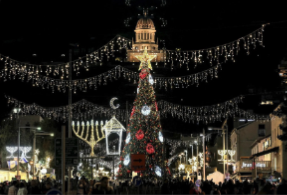
• Israel is home to many of Christianity’s most significant sites, including the Church of the Holy Sepulchre, Capernaum, Mount of Beatitudes, and the Via Dolorosa, among others. Israeli law protects these sites and ensures freedom of access.
• Israel welcomes Christian pilgrims from around the world to safely visit these holy sites, including millions of Americans.
• In Iraq and Syria, ISIS destroyed numerous ancient Christian sites, as part of an intentional effort to eliminate the Christian presence in the region; Syrian Christians continue to face violence, even under the new al-Shaara government.
• In Egypt, Coptic Christian churches have faced a wave of bombings and deadly attacks, and the government has asserted ownership of the world’s oldest Christian monastery.
• In Turkey, the government has converted the Hagia Sophia and Chora Church into mosques.

The United States and Israel share a common interest in protecting religious liberty in their own countries and around the world. The two countries should continue to work together to promote religious tolerance and freedom with meaningful people-to-people ties built on shared values and history.